
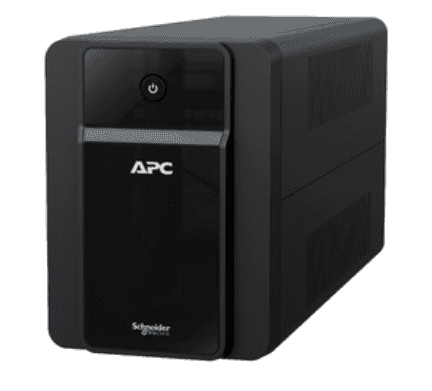
When Indian households start shopping for voltage stabilizers, a common question comes up almost immediately: should you buy one large stabilizer for the entire house, or a separate APC Line-R unit for each sensitive appliance? The answer isn’t the same for every home, and getting it wrong either wastes money or leaves your TV, refrigerator, and AC exposed to the very voltage swings you’re trying to prevent. This guide breaks down how APC Line-R stabilizers actually work, when a centralized approach makes sense, and when per-appliance protection is the smarter buy.
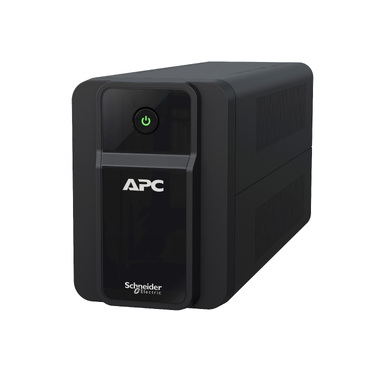
How APC Line-R Stabilizers Actually Work
APC Line-R models (600VA, 1200VA, and 1500VA being the common Indian options) use Automatic Voltage Regulation (AVR) with boost and trim transformers. They continuously correct incoming voltage — typically accepting a wide input range like 140V–300V — and deliver a stable, tighter output band (often 200V–230V) to whatever is plugged in. Line-R units do not store energy; they don’t give you backup runtime during a power cut. Their only job is to smooth out sags, surges, and fluctuations in real time.
This matters for the centralized-vs-separate decision, because a stabilizer’s effectiveness depends heavily on matching its wattage rating and regulation range to the actual load connected to it — not on how many appliances you can technically plug in.
The Case for Separate, Per-Appliance Stabilizers
Most Indian homes get better real-world protection from dedicated, appropriately-sized units for each sensitive appliance. Here’s why:
- Precision matching: A refrigerator’s compressor start-up current behaves very differently from a CRT-free flat TV’s steady draw. Sizing a stabilizer to the specific appliance keeps the AVR working in its ideal range instead of constantly overcorrecting for a mixed, unpredictable load.
- Isolation of faults: If one stabilizer fails or its relay wears out, only that appliance loses protection — the rest of the house stays covered.
- Lower individual cost, spread over time: A 600VA Line-R for a TV or music system costs far less upfront than a large centralized unit, so you can protect appliances gradually as budget allows.
- Better fit for high-inrush appliances: Air conditioners and refrigerators draw a heavy surge at startup. A correctly sized dedicated stabilizer (often 1500VA-class or higher-capacity models built for AC use) handles this cleanly, whereas a shared centralized unit sized for average load can struggle during simultaneous startups.
When a Centralized Approach Makes Sense
A single, larger stabilizer at the main distribution board can work well in specific situations:
- You live in an area with genuinely severe, house-wide voltage instability (not just one problem appliance), confirmed by actually checking your incoming voltage over a few days.
- You want simplified wiring and a single point of maintenance rather than multiple boxes across rooms.
- Your total connected load is well-defined and doesn’t include very high-inrush appliances that would need oversized single-appliance protection anyway.
The trade-off: a centralized unit is a bigger upfront investment, and if it fails or needs servicing, every connected appliance loses voltage protection simultaneously — which is a real risk during peak summer months when swings are most frequent.

Quick Comparison
| Factor | Centralized Stabilizer | Per-Appliance Line-R Units |
|---|---|---|
| Upfront cost | Higher, one-time | Lower per unit, spread over time |
| Protection precision | Averaged across mixed loads | Matched to each appliance’s actual draw |
| Fault isolation | One failure affects whole house | Failure limited to one appliance |
| Best for | Uniform, well-defined house-wide load | Mixed appliances, phased budget, high-inrush loads like AC/fridge |
| Wiring complexity | Simpler, single point | Multiple points, more flexible placement |
Sizing Tips If You Choose Separate Units
- Check the wattage rating on each appliance’s nameplate, not just its physical size.
- Add roughly 25-30% headroom for inrush current, especially for refrigerators and window/split ACs.
- For TVs, set-top boxes, and music systems, a 600VA Line-R is usually sufficient.
- For refrigerators and 1-ton ACs, look at 1200VA–1500VA class units built for higher surge tolerance.
- If you also want backup runtime (not just voltage correction) for a PC or router, a Back-UPS with built-in AVR may be a better single-box solution than a separate stabilizer plus UPS.
Whichever route you choose, it helps to browse the full range of <a href=
Shop what this guide covers
- APC Back-UPS — for home & small officeLine-interactive UPS for desktops, Wi-Fi routers, CCTV and billing machines.
- APC Line-R voltage stabilizersProtection against the voltage swings that shorten equipment life.
What size UPS do I need? »Find the battery for my UPS »Ask us on WhatsApp
Related guides
- How Many Appliances Can You Plug Into One APC Line-R Stabilizer? Outlet & Load Planning Guide (India 2026)
- Does an APC Line-R Stabilizer Protect You During a Power Cut? What It Can (and Can’t) Do in India (2026)
- APC Line-R Stabilizer Specs Decoded: Which Features Actually Matter Before You Buy (India 2026)
- APC Line-R vs Servo Stabilizer: Which Voltage Stabilizer Should You Buy in India? (2026 Guide)
- Is Your Home’s Voltage Actually Unstable? How to Check Before Buying an APC Line-R Stabilizer (India 2026)
All UPS & power-backup guides · APC battery replacement chart · APC UPS dealer in your city