
More Indian homes now run oxygen concentrators, CPAP machines, nebulizers and BiPAP devices for long-term care — often in areas where grid voltage swings between 180V and 260V through the day. These are not ordinary appliances; a motor stall, an unexpected restart, or a damaged compressor mid-session can be a genuine health risk, not just an inconvenience. If you’re buying a voltage stabilizer for medical equipment at home, it’s worth understanding exactly what a stabilizer does, what it doesn’t, and when you actually need a UPS instead — or both.

Why Medical Equipment Is Especially Sensitive to Voltage Fluctuation
Oxygen concentrators and CPAP machines use precision motors, compressors and microprocessor-controlled valves. These components are calibrated to run within a narrow voltage band. When Indian mains voltage sags during peak evening load or spikes after a transformer switch, three things can happen:
- The compressor motor in an oxygen concentrator runs hotter or slower, reducing oxygen purity output
- Internal control boards reset or throw error codes, interrupting therapy mid-use
- Repeated under/over-voltage stress shortens the life of the compressor and power supply, leading to expensive out-of-warranty repairs
A voltage stabilizer for medical equipment like the APC Line-R corrects this by continuously boosting or bucking the incoming voltage back to a safe band before it reaches the device — but it does nothing once the power actually goes off.
Stabilizer vs UPS: Which Problem Are You Actually Solving?
This is the single most important distinction for medical-equipment buyers, because the two devices solve different problems:
| Device | Protects against voltage fluctuation | Keeps device running during a power cut | Best for |
|---|---|---|---|
| APC Line-R Stabilizer | Yes | No | Areas with unstable voltage but reliable power supply |
| APC Back-UPS (with AVR) | Partial (built-in AVR, limited range) | Yes (battery backup) | Short-to-medium power cuts, general home use |
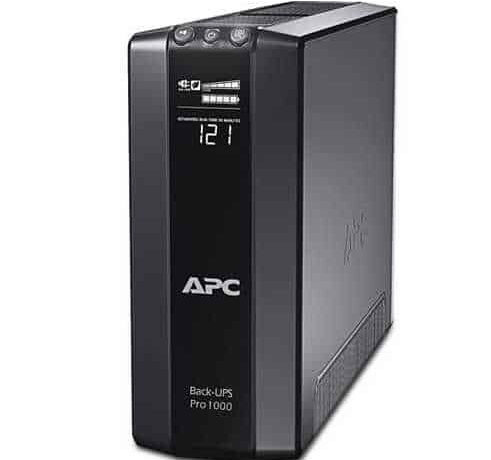
| APC Back-UPS Pro / Line-Interactive UPS | Yes (wider AVR range + pure sine wave) | Yes | Single critical device like a CPAP or concentrator |
| Online UPS (double conversion) | Yes (continuous regeneration) | Yes (zero transfer time) | Clinics, multi-bed home care, hospital-grade reliability |
If your area simply has frequent brownouts but power cuts are rare, a dedicated stabilizer from the APC Line-R voltage stabilizers range may be sufficient to protect the device from damage. But if power cuts are common — as in most of India — a stabilizer alone will not keep an oxygen concentrator running when it matters most. For that, you need a UPS with sufficient AVR range and runtime.
Why Pure Sine Wave Matters More Here Than for Other Appliances
Oxygen concentrators and CPAP machines contain compressor motors, which are far more sensitive to waveform quality than a laptop charger or LED bulb. A modified sine wave (stepped approximation) output can cause motor humming, overheating, and reduced efficiency over time. This is why, for medical devices specifically, we recommend either a true pure sine wave Back-UPS Pro (BR series) or a line-interactive UPS rather than an entry-level stabilizer-only or square-wave backup setup.
Sizing: Matching the Stabilizer or UPS to the Load
Typical power draw for common home medical devices:
- Oxygen concentrator (5L): 300–450W continuous, with a startup surge
- CPAP/BiPAP machine: 30–70W
- Nebulizer: 80–120W
- Home ventilator (where used): 100–200W
For a single oxygen concentrator, an APC Line-R model rated around 600VA–1200VA (such as the LS or LM series) comfortably covers the running load with headroom for the compressor’s startup surge. If you’re combining a concentrator with a CPAP machine on the same circuit, size up to the next tier rather than running both near full capacity — compressor startup current briefly exceeds the nameplate rating.

For Clinics and Multi-Bed Home Care
If you’re a small clinic, diagnostic centre, or home-care provider running several oxygen concentrators, nebulizers and monitoring devices together, a single stabilizer per device becomes impractical. In this case, an online UPS with double-conversion topology is a better fit — it continuously regenerates clean, regulated power with zero transfer time, so devices never experience even a momentary interruption when switching from mains to battery. For bulk procurement across multiple rooms or beds, you can configure the exact combination of UPS and stabilizer units and get an instant, itemised quotation with GST and freight through our online quote builder — no back-and-forth with a salesperson required.
Frequently Asked Questions
Can a stabilizer alone keep an oxygen concentrator running during a power cut?
No. A stabilizer only regulates incoming voltage while mains power is present. The moment power is cut, the stabilizer also goes off. For continuous operation during outages, you need a UPS with sufficient battery runtime.
Is a regular APC Back-UPS enough, or do I need a separate stabilizer too?
Most APC Back-UPS models include built-in AVR (automatic voltage regulation), which handles typical fluctuations without a separate stabilizer. A standalone Line-R is more useful when voltage swings are frequent and severe, or when you want to protect the device even on days you don’t need battery backup.
How much backup time should I plan for a home oxygen concentrator?
At minimum, plan for 1–2 hours of continuous runtime to cover typical short outages, and consider a higher-capacity battery or a second RBC battery pack if your area has longer, unpredictable cuts.
Should a clinic use the same setup as a home user?
No. A clinic with multiple devices running simultaneously should move to an online UPS for zero transfer time and tighter voltage regulation, rather than relying on multiple small stabilizers or Back-UPS units per device.
Shop what this guide covers
- Genuine APC RBC replacement batteriesFactory-sealed APC Replacement Battery Cartridges with full manufacturer warranty.
- APC Back-UPS — for home & small officeLine-interactive UPS for desktops, Wi-Fi routers, CCTV and billing machines.
- APC Smart-UPS & online UPSDouble-conversion, pure sine-wave power for servers, racks and critical loads.
- APC Line-R voltage stabilizersProtection against the voltage swings that shorten equipment life.
What size UPS do I need? »Find the battery for my UPS »Ask us on WhatsApp
Related guides
- Voltage Stabilizer vs UPS: Which One Does Your Home or Office Actually Need? (India 2026 Decision Guide)
- Voltage Stabilizer for Water Purifiers, Microwaves & Kitchen Appliances: Do You Need an APC Line-R in India? (2026 Buying Guide)
- Do You Need an APC Line-R Stabilizer for Your TV & Home Theatre? (India 2026 Buying Guide)
- Decoding APC Line-R Models: LE vs LS vs LM vs H Series — Which Stabilizer Should You Buy? (India 2026)
- Voltage Stabilizer or UPS for Your Gaming PC? Which Should You Buy in India? (2026 Guide)
All UPS & power-backup guides · APC battery replacement chart · APC UPS dealer in your city