
If you’ve ever compared two APC UPS models with similar VA ratings but very different prices, the output waveform is often the hidden reason. Some UPS units deliver a pure sine wave output, while cheaper line-interactive models produce a stepped (simulated) sine wave. For most Indian homes and offices this distinction matters more than people realise — it affects whether your PC switches over smoothly, whether your appliances buzz, and how long your equipment lasts. This guide explains the difference in plain language and helps you pick the right type for your load.

What Is a Sine Wave, and Why Does It Matter?
Indian grid power arrives as a smooth, continuous AC sine wave at 230V/50Hz. Your appliances are designed to run on exactly this shape. When a UPS switches to battery during an outage, it has to recreate that AC waveform from DC battery power using an inverter circuit. How accurately it does this defines the output type:
- Pure sine wave: A smooth curve practically identical to grid power. Every device runs cleanly.
- Stepped / simulated sine wave (also called modified sine wave): An approximation built from blocky voltage steps. It works for many devices but is "rougher" electrically.
The Key Differences at a Glance
| Factor | Pure Sine Wave | Stepped Sine Wave |
|---|---|---|
| Waveform quality | Smooth, grid-like | Blocky approximation |
| Compatibility | Works with everything | Fine for basic loads, problematic for sensitive ones |
| Noise/buzzing | Silent operation | Can cause humming in motors/fans |
| Heat in equipment | Minimal | Slightly higher in some devices |
| Price | Higher | Lower |
| Typical APC range | Back-UPS Pro (BR), Easy-UPS, Smart-UPS | Back-UPS (BX) entry models |
Which Devices Actually Need a Pure Sine Wave?
This is where buyers waste money in both directions — either overpaying for a feature they don’t need, or damaging gear by underspending. Here’s a practical breakdown for Indian setups:
Strongly recommend pure sine wave
- PCs with Active PFC power supplies — Most modern gaming and workstation PSUs use Active Power Factor Correction. On a stepped wave they may shut down, restart randomly, or refuse to switch to battery at all.
- Gaming rigs and high-end workstations — Sensitive, expensive components deserve clean power.
- Medical equipment like CPAP machines and nebulizers used at home.
- Audio/AV gear, laser printers, and devices with motors that buzz or overheat on rough power.
Stepped sine wave is usually fine
- Wi-Fi routers, modems, and ONT boxes
- Basic desktop PCs with older non-PFC power supplies
- LED lights, set-top boxes, and small chargers
- CCTV DVRs/NVRs and IP cameras
If you run a mixed load and are unsure about your PC’s power supply, the safer choice is always pure sine wave. The price gap on a 1000VA-class unit is modest compared to the cost of a damaged or unstable system.
The Active PFC Problem (Important for PC Owners)
This deserves its own section because it trips up so many people. Active PFC power supplies expect a clean sine wave to charge their internal capacitors. When fed a stepped wave, the abrupt voltage transitions can confuse the PSU’s protection circuitry. The result during a power cut is often:
- The PC abruptly shuts off instead of switching to battery
- The UPS clicks/relays chatter repeatedly
- An audible buzz or whine from the PSU
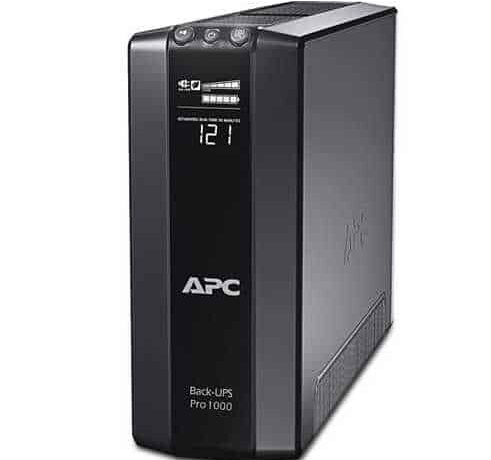
Since nearly every PC built in the last several years uses Active PFC, anyone protecting a desktop should treat pure sine wave as the default. The APC Back-UPS Pro 1000VA (BR1000G-IN) is a popular choice precisely for this reason.
APC Lineup: Mapping Models to Waveform
Here’s a simplified way to remember the APC families sold in India:
- Back-UPS (BX) series — Entry-level, typically stepped sine wave. Great for routers, basic loads and budget setups. See the Back-UPS 1100VA (BX1100C-IN).
- Back-UPS Pro (BR) series — Pure sine wave, designed for PCs with Active PFC, gaming, and sensitive electronics.
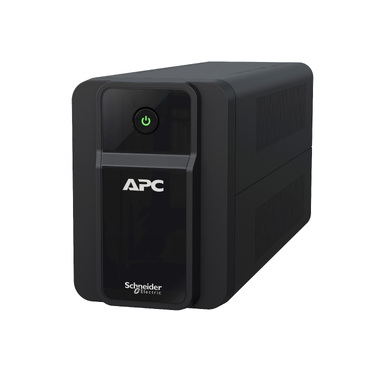
- Easy-UPS / Smart-UPS — Pure sine wave with stronger features for offices and servers.
You can browse the full range in our UPS collection to compare VA ratings and waveform per model.
How to Decide in 30 Seconds
Ask yourself three quick questions:
- Am I protecting a modern desktop PC, gaming rig, or expensive electronics? → Pure sine wave.
- Is this just for my router, modem, or a basic appliance? → Stepped sine wave is fine and saves money.
- Am I unsure what my PSU type is? → Default to pure sine wave for peace of mind.
Common Myths to Ignore
- "Higher VA means pure sine wave." False — VA rating (capacity) and waveform are independent specs. Always check the datasheet.
- "Stepped sine wave will fry my router." No — low-power switching adapters tolerate it well.
- "All UPS are the same once the power is on." The waveform only matters on battery, but that’s exactly when your equipment is most vulnerable.
The Bottom Line
For Indian buyers, the rule is simple: protect computers and sensitive gear with a pure sine wave UPS, and use a stepped sine wave unit for routers and low-power devices to save cost. The waveform is one of the most overlooked specs, yet it directly affects reliability during the exact moment you bought a UPS for — a power cut. Match the waveform to your load, confirm the VA rating covers your devices, and you’ll have a backup setup that switches over silently and protects your equipment for years.
Shop what this guide covers
- APC BX1100C-IN battery replacementThe correct RBC2 cartridge for the BX1100C-IN (1100VA).
- APC BR1000G-IN battery replacementThe correct RBC144 cartridge for the BR1000G-IN (1000VA).
- APC Back-UPS — for home & small officeLine-interactive UPS for desktops, Wi-Fi routers, CCTV and billing machines.
- APC Smart-UPS & online UPSDouble-conversion, pure sine-wave power for servers, racks and critical loads.
What size UPS do I need? »Find the battery for my UPS »Ask us on WhatsApp
Related guides
- Does APC Extended Warranty Cover Lightning & Voltage Surge Damage in India? (2026 Buyer’s Guide)
- Does Your APC Line-R Stabilizer Need Earthing? Installation & Safety Checklist Before You Buy (India 2026)
- APC Smart-UPS Online Running Costs in India: Double-Conversion Efficiency, ECO Mode & Electricity Bills Explained (2026)
- Ideal Load Percentage for Your APC Back-UPS: How Much Headroom Should You Buy in 2026? (India Guide)
- APC RBC vs Generic Replacement Battery: Which One Should You Buy for Your UPS in India? (2026 Guide)
All UPS & power-backup guides · APC battery replacement chart · APC UPS dealer in your city