
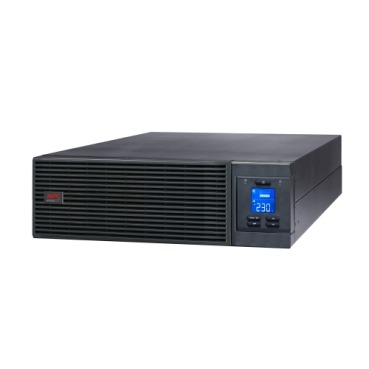
Every APC brochure for servers and data centres mentions “pure sine wave output,” but very few buyers actually check what that means in the datasheet, or whether it changes between models. If you’re specifying a pure sine wave online UPS for a server rack, a hospital diagnostic machine, or a CNC controller, understanding Total Harmonic Distortion (THD) specs is far more useful than just trusting the marketing phrase. Here’s what actually matters before you sign off on a purchase order.

Why Pure Sine Wave Output Matters for Servers and Critical Loads
Server power supplies, storage arrays, networking switches and medical/lab equipment are designed to run on a clean, continuous sine wave — the same waveform the Indian grid is supposed to deliver. A distorted or stepped waveform forces the internal power supply unit (PSU) of a server to work harder, generates extra heat, and in some cases triggers PSU faults or reduced component life. For always-on IT loads running 24×7, even a small, chronic distortion adds up over years.
Online (Double-Conversion) vs Line-Interactive: Who Actually Delivers Pure Sine Wave
This is where the confusion usually starts. Not all UPS topologies treat the output waveform the same way:
| Topology | How output is generated | Waveform under normal mains | Waveform on battery |
|---|---|---|---|
| Online / Double-Conversion (APC Smart-UPS Online, Easy-UPS SRV/SRT) | Input AC → rectified to DC → inverted back to AC continuously | Pure sine wave, always | Pure sine wave, no change |
| Line-Interactive (APC Smart-UPS SMT/SMC, Back-UPS Pro BR) | Mains passes through AVR; inverter only activates on battery | Same as incoming mains (grid-dependent) | Pure sine wave (on BR/SMT/SMC models) |
| Standby UPS (basic Back-UPS BX) | Mains passed through directly; inverter only on battery | Same as incoming mains | Stepped/simulated sine wave on most BX models |
The key difference: in a true online UPS, your server never sees raw mains at all — it always runs on the inverter’s clean output, whether the grid is stable, sagging, or completely absent. That’s why double-conversion units are the standard choice for server rooms, not just for backup time but for continuous power conditioning. You can browse the full online UPS range to compare models by capacity and runtime.
Reading THD Specs in an APC Datasheet
THD (Total Harmonic Distortion) tells you how far the output deviates from an ideal sine wave, expressed as a percentage. Lower is better.
- Online APC models (SRV, SMT/SMX in online mode, SRT): typically rated at ≤3% THD on linear loads — this is considered true pure sine wave and safe for all IT equipment, including SMPS-based servers and precision electronics.
- Line-interactive APC models (SMC, SMT on battery): output THD on battery is also usually ≤5%, acceptable for most servers but not as tightly controlled as online units.
- Standby Back-UPS (BX series) on battery: not specified in THD terms because the output is intentionally a stepped approximation, not a true sine wave — fine for a PC or router, not ideal for a server PSU or an inductive load like a split AC compressor.
Does a Wide Input Voltage Window Change the Output Waveform?
No — and this is the point most buyers miss. An online UPS’s double-conversion design means the output inverter is completely decoupled from input fluctuations. Whether incoming voltage is 160V or 280V (common on unstable Indian LT feeders), the rectifier/inverter stage regenerates a fresh, regulated sine wave every single cycle. This is different from a stabilizer-plus-UPS combination, where the stabilizer corrects voltage but the UPS’s own topology still determines waveform quality on battery.

Checklist Before You Buy a Pure Sine Wave Online UPS
- Confirm the datasheet explicitly states
Shop what this guide covers
- APC Back-UPS — for home & small officeLine-interactive UPS for desktops, Wi-Fi routers, CCTV and billing machines.
- APC Smart-UPS & online UPSDouble-conversion, pure sine-wave power for servers, racks and critical loads.
What size UPS do I need? »Find the battery for my UPS »Ask us on WhatsApp
Related guides
- APC Smart-UPS Online Running Costs in India: Double-Conversion Efficiency, ECO Mode & Electricity Bills Explained (2026)
- Hardwired or Plug-In? APC Smart-UPS Input/Output Connections Explained Before You Buy (India 2026)
- APC Extended Warranty for Back-UPS vs Smart-UPS Online: How Coverage, Price & Service Differ (India 2026)
- Tower vs Rack-Mount APC Smart-UPS Online: Which Form Factor Should You Buy for Your Server Room? (India 2026)
- Standard Runtime vs Long Runtime APC Smart-UPS Online: Which Should You Buy for Your Server Room? (India 2026)
All UPS & power-backup guides · APC battery replacement chart · APC UPS dealer in your city