
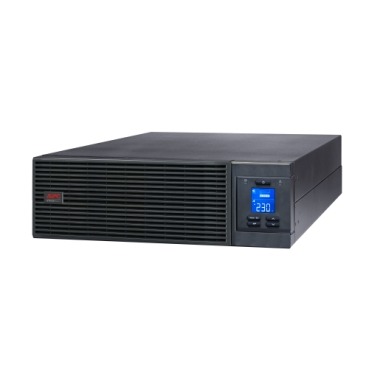
If you’ve been searching for a server UPS, you’ve probably noticed that APC sells several products under the “Smart-UPS” name — SRT, SMT, SMC — and assumed they’re all the same double-conversion online technology. They’re not. Some Smart-UPS models are true online UPS systems, while others are line-interactive units wearing the same badge. Buying the wrong one for a server or critical load can mean voltage sags reaching your equipment instead of clean, regulated power. Here’s how to tell them apart before you place an order.

Why the Naming Gets Confusing
APC’s “Smart-UPS” branding has been used across multiple generations and technologies sold in India, which is why buyers get mixed up. Broadly, three families show up under this name:
- SMC — entry-level Smart-UPS, line-interactive topology, stepped or pure sine wave output depending on model.
- SMT/SMX — mid-range Smart-UPS, still line-interactive, better voltage regulation range and management options than SMC.
- SRT — true online double-conversion UPS, designed for servers, racks and critical loads that cannot tolerate any transfer time.
Only the SRT series (and APC’s Easy-UPS SRV/SRC business range) uses genuine double-conversion online technology. SMT and SMC are line-interactive — very capable for general office and desktop protection, but not the same class of protection as an online UPS.
Online vs Line-Interactive: The Core Difference
In a line-interactive UPS (SMC, SMT), your equipment runs on mains power most of the time, with the UPS stepping in and correcting voltage through a tap-changing transformer or AVR circuit. There’s still a brief transfer time (a few milliseconds) when switching to battery.
In a true online UPS (SRT, SRV), the incoming AC is continuously converted to DC and back to clean AC — your load always runs off the inverter, never directly off raw mains. There is zero transfer time and the output is fully isolated from input voltage fluctuations, frequency variation and noise. This is why data centres, hospital equipment and industrial controllers specify online UPS as a mandatory requirement.
Quick Comparison Table
| Feature | SMC (entry) | SMT/SMX (mid-range) | SRT (true online) |
|---|---|---|---|
| Topology | Line-interactive | Line-interactive | Double-conversion online |
| Transfer time | 2–4 ms typical | 2–4 ms typical | Zero (0 ms) |
| Output waveform | Pure sine wave | Pure sine wave | Pure sine wave, isolated |
| Best for | Desktops, small office loads | Small server, POS, networking racks | Servers, storage, racks, industrial controllers |
| Typical VA/kVA range in India | ~750 VA – 1.5 kVA | ~1 kVA – 3 kVA | 1 kVA to 10 kVA+ (rack & tower) |
| Runtime expansion | Limited/none | Limited | External Battery Module (EBM) supported |
How to Decide Which One You Need
Use this quick decision list:
- Choose SMC/SMT if you’re protecting desktops, POS terminals, small network switches, or a single low-load server in a small office where brief transfer time is acceptable.
- Choose SRT (or an Easy-UPS SRV/SRC online model) if you’re running a production server, NAS/SAN storage, a VoIP/PBX system, medical equipment, or any rack where even a few milliseconds of transfer can cause a reboot or data corruption.
- Choose SRT with hot-swappable batteries if uptime during battery replacement matters — you can swap batteries without powering down the load.
- Add an Extended Battery Module (EBM) to an SRT unit if your server room needs more than the standard 5–10 minute runtime at full load.
If your business is scaling and you’re comparing multiple sizes, it’s worth browsing the full APC online UPS range to see the SRT and Easy-UPS SRV models side by side by kVA rating, rather than guessing from datasheets alone. For smaller branch offices where a line-interactive unit is genuinely sufficient, the line-interactive UPS category covers the SMC/SMT range at a lower entry cost.

A Note on Indian Power Conditions
India’s grid throws frequent voltage sags, brownouts and micro-interruptions rather than clean total outages. Line-interactive units (SMC/SMT) handle this reasonably well for general office equipment because their AVR circuit corrects voltage swings without switching to battery every time. But for servers, the concern isn’t just voltage — it’s the transfer time itself. Even a well-regulated line-interactive UPS switches to battery during a sag, and that switch can be enough to trip a sensitive PSU or cause a controlled shutdown on some server-grade power supplies. This is the exact reason IT teams standardise on SRT-class online UPS for anything rack-mounted and revenue-critical.
Sizing Tip Before You Buy
Whichever series you shortlist, always size by real load in watts (not VA) after accounting for power factor, and add at least 20–25% headroom for future expansion. If you’re ordering for multiple server racks or branch offices, generating a formal instant UPS quotation with GST and freight included makes it far easier to compare SRT and SMT configurations side by side before your procurement team signs off.
Frequently Asked Questions
Is every APC Smart-UPS an online UPS?
No. Only the SRT series (and the separate Easy-UPS SRV/SRC business range) use true double-conversion online technology. SMC and SMT Smart-UPS models are line-interactive.
Can I use an SMT line-interactive UPS for a small server?
Yes, for light, non-critical servers where a few milliseconds of transfer time won’t cause issues. For production servers, storage arrays or anything with strict uptime requirements, an SRT online UPS is the safer choice.
Does an online UPS cost significantly more than a line-interactive Smart-UPS?
Generally yes, because of the double-conversion inverter design and typically better battery/EBM support. The extra cost buys zero transfer time and full output isolation — usually worth it for business-critical loads.
Can I add extra battery runtime to an SMT or SRT UPS later?
SRT-series and most Easy-UPS SRV models support external battery modules for extended runtime. SMC and most SMT models have limited or no external battery expansion, so check the datasheet before assuming you can scale runtime later.
Shop what this guide covers
- APC BR1500G-IN battery replacementThe correct RBC144 cartridge for the BR1500G-IN (1500VA).
- Which APC UPS for Servers & Server Racks?Load table, VA sizing and the genuine APC units we stock for it.
- APC Back-UPS — for home & small officeLine-interactive UPS for desktops, Wi-Fi routers, CCTV and billing machines.
- APC Smart-UPS & online UPSDouble-conversion, pure sine-wave power for servers, racks and critical loads.
What size UPS do I need? »Find the battery for my UPS »Ask us on WhatsApp
Related guides
- How Long Will Your APC Smart-UPS Online Really Last? Runtime vs Load Guide for Indian Server Rooms (2026)
- APC Smart-UPS Online Running Costs in India: Double-Conversion Efficiency, ECO Mode & Electricity Bills Explained (2026)
- APC RBC vs Generic Replacement Battery: Which One Should You Buy for Your UPS in India? (2026 Guide)
- Hardwired or Plug-In? APC Smart-UPS Input/Output Connections Explained Before You Buy (India 2026)
- APC Back-UPS Features Decoded: LCD, AVR & USB Monitoring — What Actually Matters Before You Buy (India 2026)
All UPS & power-backup guides · APC battery replacement chart · APC UPS dealer in your city