
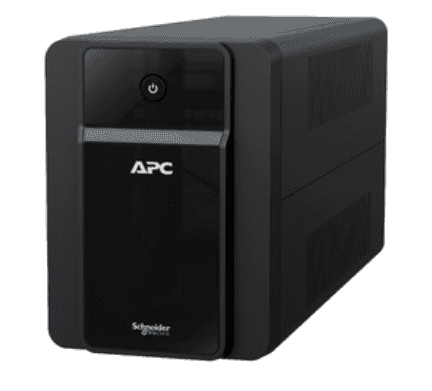
Most Indian buyers size an APC Back-UPS by matching VA to their devices and stop there — but the number that actually determines battery life, runtime accuracy and future flexibility is load percentage. Buy a UPS that runs near 100% load and you’ll get short backup, hot batteries and a unit that can’t take on even one more device. This guide explains what load percentage means, what’s safe, and how to buy with the right headroom.
What Is UPS Load Percentage?
Load percentage is the ratio of the power your connected devices actually draw to the UPS’s maximum rated capacity. An APC Back-UPS BX1100 rated at 1100VA/660W running a 400W desktop + monitor setup is operating at roughly 60% load. The LCD or monitoring software on most APC models displays this figure in real time, and it’s far more useful to watch than the VA rating printed on the box.
Why Running Near 100% Load Is a Problem
- Shorter backup time: Runtime drops sharply as load rises — a UPS that gives 15 minutes at 50% load might give under 5 minutes at 90% load.
- Battery stress: Heavy, repeated discharge cycles near full capacity age the internal battery faster, shortening the life of your RBC replacement cartridge.
- Nuisance overload alarms: Indian homes often add a printer, a second monitor or a small appliance later — pushing an already-tight UPS into overload beeping.
- No safety margin for surges: Motor-start loads (printers, external HDDs) draw a brief surge above their rated wattage; a UPS with no spare capacity can trip or shut down at that exact moment.
What Load Percentage Should You Buy For?
As a practical rule for Indian homes and small offices, size your APC Back-UPS so your everyday load sits at 40-60% of its rated capacity at the time of purchase. This leaves room for added devices over the next 2-3 years without forcing a replacement.
| Load % at Purchase | What It Means | Recommendation |
|---|---|---|
| Under 30% | Oversized for current needs | Fine if you plan to add load soon; otherwise you’re paying for unused capacity |
| 40-60% | Ideal buying range | Good runtime, healthy battery life, room to grow |
| 60-80% | Acceptable but tight | Fine for fixed, known loads with no planned additions |
| Above 80% | Undersized | Move up a model before purchase — do not buy at this margin |
Worked Example: Desktop + Monitor + Router
A typical home office load — a desktop (250W), an LED monitor (30W) and a Wi-Fi router (15W) — totals around 295W. Converted to VA at a 0.6 power factor, that’s roughly 490VA of actual draw. Buying an APC Back-UPS 600VA would push you close to 80% load immediately, leaving no headroom. An APC Back-UPS 1100VA (BX1100), by contrast, keeps this same load at around 45%, giving longer runtime and space to add a printer later.

How to Calculate Your Load Before Buying
- List every device that will stay connected to the UPS (not the whole room — just backed-up loads).
- Add up their wattage from the rating label or power adapter.
- Divide total watts by 0.6 to estimate VA (APC Back-UPS units typically carry this power factor).
- Pick a model where this VA figure is 40-60% of the UPS’s rated VA.
If you’re unsure how to measure actual draw rather than relying on label wattage, a watt-meter check before purchase gives far more accurate numbers than guesswork. For browsing models by capacity, the full range of APC line-interactive UPS systems lists VA ratings and output wattage side by side, making this comparison easier.
Load Percentage Also Affects Battery Life
A UPS run consistently near full load discharges its battery more deeply during every power cut, which accelerates capacity loss. If your current UPS already shows high load percentages and the battery is underperforming, check the APC RBC replacement battery range for your model — but also consider whether the real fix is a higher-capacity UPS rather than another battery swap on an undersized unit.
Buying for an Office with Multiple Desks
Offices sizing UPS units per desk or per rack should apply the same 40-60% rule per unit, then add a few spare outlets for shared peripherals. For multi-unit orders, it’s worth generating a GST-ready quotation across models and quantities using the online quotation builder, which totals cost and freight in minutes without waiting on a salesperson.
Frequently Asked Questions
Does APC show load percentage on every Back-UPS model?
Entry-level models without an LCD don’t display it directly, but APC’s free PowerChute software (on USB-connected models) and most BX/BR models with an LCD panel show real-time load percentage.
Is it bad to run a UPS at very low load, like 20%?
Not harmful to the UPS itself, but it usually means you’ve overpaid for capacity you don’t need — unless you’re intentionally future-proofing for added devices.
Can I just upgrade the battery instead of buying a higher-VA UPS?
A bigger RBC battery can extend runtime slightly, but it won’t change the load percentage or reduce overload risk — it only helps if the unit was undersized due to short backup time, not capacity.
How much headroom should a CCTV + router setup have?
Since these are low-wattage, always-on loads, even an APC Back-UPS 600VA often sits well under 50% load with just a router and DVR — but check your specific DVR and camera wattage before assuming.
Shop what this guide covers
- APC BR1500G-IN battery replacementThe correct RBC144 cartridge for the BR1500G-IN (1500VA).
- Genuine APC RBC replacement batteriesFactory-sealed APC Replacement Battery Cartridges with full manufacturer warranty.
- APC Back-UPS — for home & small officeLine-interactive UPS for desktops, Wi-Fi routers, CCTV and billing machines.
- Build an instant APC UPS quotationGST worked out, freight to your pincode, numbered PDF emailed in about a minute.
What size UPS do I need? »Find the battery for my UPS »Ask us on WhatsApp
Related guides
- How to Measure Your Actual Load Before Buying an APC Back-UPS: A Watt-Meter Sizing Method (India 2026)
- APC Back-UPS Features Decoded: LCD, AVR & USB Monitoring — What Actually Matters Before You Buy (India 2026)
- APC Back-UPS vs APC Easy-UPS BVX: Should You Buy a Lithium-Ion UPS for Home or Office in India? (2026)
- Cold-Start Feature in APC Back-UPS: Why It Matters for Wi-Fi Routers & CCTV During Long Power Cuts (India 2026)
- How Many Appliances Can You Plug Into One APC Line-R Stabilizer? Outlet & Load Planning Guide (India 2026)
All UPS & power-backup guides · APC battery replacement chart · APC UPS dealer in your city