
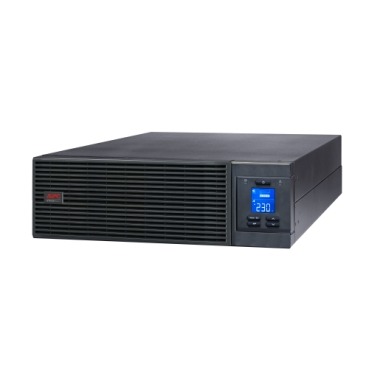
If your business runs a server rack, an NVR wall or a small data closet, one question comes up right before purchase: should you buy a single large APC online UPS, or two smaller units in an N+1 redundant configuration? Both cost roughly the same in many cases, but they behave very differently during a fault, a battery failure or a maintenance window. This guide explains the trade-offs in plain terms, with Indian power realities and real APC models in mind.

First, why online (double-conversion) for a server room?
In Indian conditions — frequent grid dips, generator changeovers, brownouts before the monsoon load peaks — a true double-conversion online UPS constantly rebuilds a clean, stable, pure sine-wave output regardless of what the input looks like. There is zero transfer time, which matters for servers, storage arrays and network cores that hate even a few milliseconds of interruption. Line-interactive units are excellent for desktops and edge devices, but for a rack carrying your critical infrastructure, browse the APC online UPS range and treat it as the baseline.
The core decision: one big UPS vs N+1 redundancy
“N+1” means you provide one more UPS unit than the load actually needs. If your rack draws 6 kW and you deploy two 6 kW-capable units sharing the load, either unit can fail and the survivor still carries everything. A single larger UPS has no such backup — if it faults, the entire rack drops.
| Factor | Single large UPS | N+1 (two units) |
|---|---|---|
| Protection if one UPS fails | None — full outage | Load continues on survivor |
| Battery/maintenance window | Requires full shutdown or bypass | Service one unit while other runs |
| Upfront cost | Lower | Higher (two units + setup) |
| Footprint & wiring | Simpler | More complex, needs STS/distribution |
| Best for | Non-critical or budget racks | Uptime-critical business loads |
How to size it correctly (the part most buyers get wrong)
Sizing failures cause more real-world problems than topology choices. Work through these steps:
- Total the real load in watts. Add the rated power of every device — servers, switches, storage, NVR, monitor. Nameplate figures are peak; typical draw is often 50–70% of that.
- Convert to VA. Modern APC online UPS have a power factor near 1.0, so watts ≈ VA. A 6000 W load needs roughly a 6 kVA rating.
- Add 20–25% headroom. This covers future expansion and keeps the UPS off its efficiency cliff. A 6 kW load points to an 8–10 kVA unit like the SRV series.
- Decide runtime, then batteries. Online UPS runtime is short by design; use external battery packs sized for your safe-shutdown time (often 10–15 minutes is enough if servers auto-shutdown gracefully).
- For N+1, size each unit to carry 100% alone. Two 10 kVA units sharing a 6 kW load run at ~30% each — comfortable, and either survives solo.
Where redundancy actually pays off in India
N+1 is not overkill for everyone, but it earns its cost when:
- Downtime has a direct revenue or SLA penalty (billing systems, POS, e-commerce, clinics).
- You cannot get an outage window to service or swap batteries during business hours.
- Your site sees rough utility power and frequent DG changeovers that stress UPS internals over time.
- You already anticipate rack growth and want the second unit to absorb it later.
If none of these apply — say, a file server and a few switches in a branch office — a single correctly-sized online UPS with a good service plan is the pragmatic choice.
Don’t forget the supporting pieces
Redundancy at the UPS level is wasted if a single point of failure sits elsewhere. Feed the two UPS units from separate breakers where possible, use a Static Transfer Switch or dual-corded PDUs for critical servers, and keep spare battery cartridges on hand — plan replacements early using genuine APC RBC replacement batteries so a weak battery string never becomes your weakest link. Finally, install network management cards and shutdown software so servers power down cleanly before batteries deplete.
A simple recommendation path
- Small closet, non-critical, tight budget: One right-sized online UPS with headroom + auto-shutdown.
- Growing SMB rack, needs maintenance flexibility: N+1 with two units each able to carry full load.
- Mission-critical, SLA-bound: N+1 plus dual power paths (STS/dual-cord PDUs) and extended battery runtime.
FAQ
Is N+1 the same as having two UPS batteries?
No. Extra batteries only extend runtime on the same UPS. N+1 means an entire additional UPS unit, so a total electronics failure in one still leaves the load powered by the other.
Can I mix a line-interactive and an online UPS for redundancy?
It is not recommended for a shared critical load. Their output characteristics and transfer behaviour differ, which can cause uneven load sharing. Keep redundant pairs on the same model family and topology.
How much runtime do I actually need for a server rack?
Usually just enough for a graceful shutdown or DG start — often 8–15 minutes. Chasing long runtime with an online UPS is expensive; instead automate shutdown and, where outages are long, pair the UPS with a generator.
Will running two units in N+1 double my electricity bill?
No. The two units share one load, so total power drawn is essentially the same as one unit carrying it, plus small idle/efficiency losses. Modern APC online UPS run at high efficiency even at partial load.
Bottom line: pick topology for your uptime needs, size for real watts plus 20–25% headroom, and never let batteries, wiring or a single feed undo your redundancy. Do that, and your rack rides through the worst Indian grid days without a flicker.
Shop what this guide covers
- Genuine APC RBC replacement batteriesFactory-sealed APC Replacement Battery Cartridges with full manufacturer warranty.
- APC Smart-UPS & online UPSDouble-conversion, pure sine-wave power for servers, racks and critical loads.
What size UPS do I need? »Find the battery for my UPS »Ask us on WhatsApp
Related guides
- Is Your Server Room Ready for an APC Online UPS? A Site-Readiness Checklist (India 2026)
- Does Your APC Online UPS Need a Maintenance Bypass Switch? A Server Room Buying Guide (India 2026)
- How Long Will Your APC Smart-UPS Online Really Last? Runtime vs Load Guide for Indian Server Rooms (2026)
- APC Smart-UPS Online Running Costs in India: Double-Conversion Efficiency, ECO Mode & Electricity Bills Explained (2026)
- Do You Need an Isolation Transformer with Your APC Online UPS? (India Buying Guide 2026)
All UPS & power-backup guides · APC battery replacement chart · APC UPS dealer in your city